

The origin of Nosferatu – Albin Grau edition
A Symphony of Horror (and Art)
Every work of art—whether a painting, sculpture, photograph, or film—largely stems from the life of the artist who created it. The social, cultural, economic, and familial context in which they lived inevitably shapes the expressive form of the work itself. This is one of the reasons I am drawn to exploring artists’ lives: it is, in my view, the only way to attempt—however partially—to see a work through their eyes, and perhaps to feel the desire and the dream that compelled its creation.
That very desire—the driving force behind any truly innovative work—can also be better understood by tracing the events of the artist’s life, from youth through growth and maturity, and perhaps even into death.
At the beginning of his career as an actor, Friedrich Wilhelm von Plumpe could not bear the weight of such a surname (in German, plump suggests something clumsy or coarse), which clashed with the innate refinement and elegance that would distinguish him throughout his life. He therefore chose the name of a quiet Bavarian town—Murnau am Staffelsee—as his artistic surname, and to this day he is known simply as Wilhelm Murnau: one of the most important German directors of the early twentieth century, and a filmmaker who left an indelible mark on the history of cinema by creating, in 1922, what is universally regarded as the first horror film of the Seventh Art. A timeless classic, and the ultimate cult movie.
Yet despite all this—and despite Murnau’s fascinating life, stretching from Europe to exotic Tahiti before ending tragically in a car accident on the road to Santa Barbara, California—it is not on him that my attention has focused.
Years ago, I had already created two remarkable statues of Nosferatu, but for some time I have felt a burning desire to explore the origins of the hypnotic image of Count Orlok, so masterfully portrayed in Murnau’s masterpiece. I wanted to understand its genesis, and above all, to discover who contributed to the aesthetic and imaginative creation of this enigmatic undead figure. Who was the true architect of his primordial form? Who sparked Murnau’s interest in such a subject? Who inspired a tale of vampirism so dark and steeped in esoteric symbolism? Who stood behind it all?
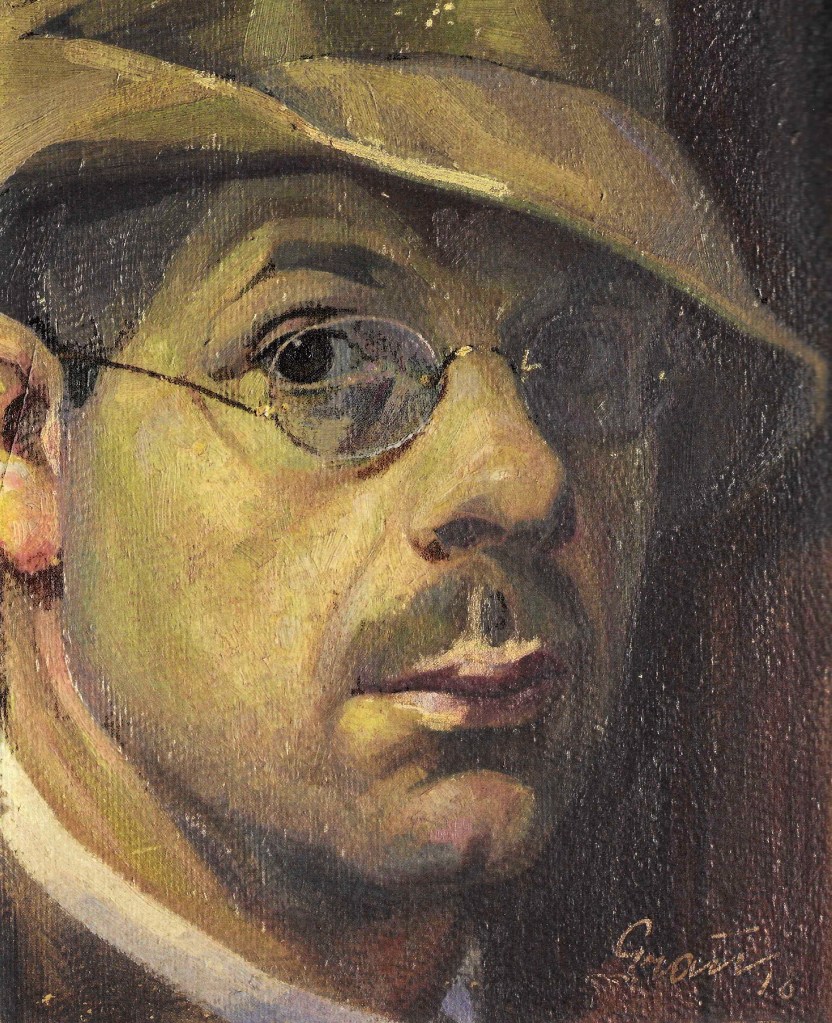
As we know, the screenplay was attributed to Henrik Galeen (already an actor, screenwriter, and director of the legendary film Der Golem), but the stylistic, historical-legendary, and esoteric influence undoubtedly belonged to the set designer and illustrator Albin Grau. Born in Leipzig, he studied at the Academy of Fine Arts in Dresden and took part in the First World War. His true passion, however, lay in occultism, which he studied and pursued intensely through the German circles and secret societies of the time.
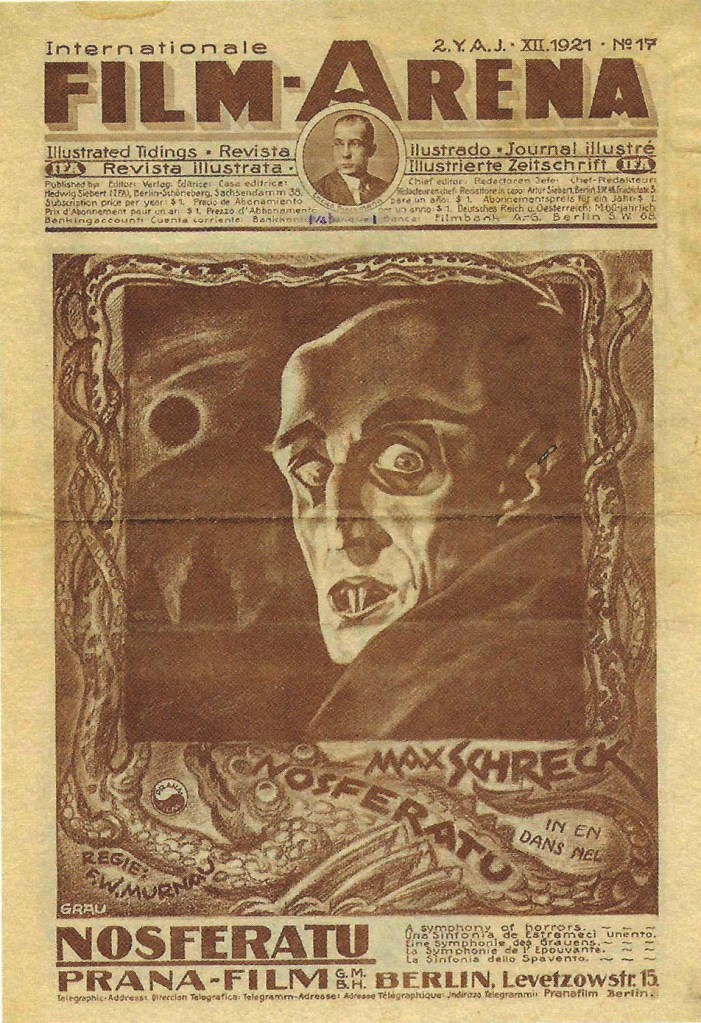
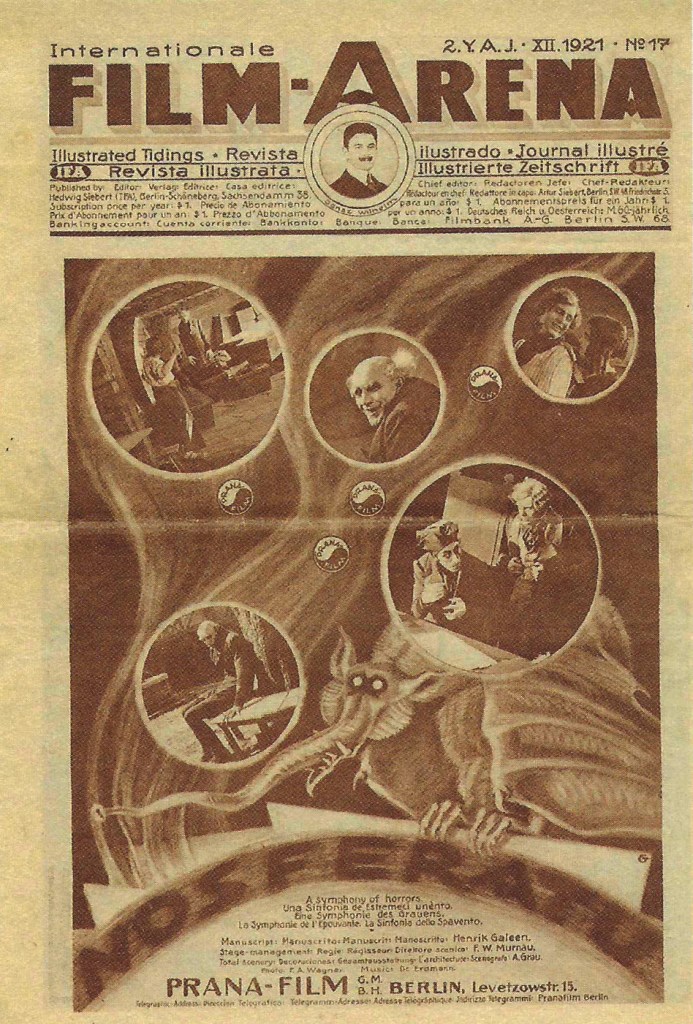
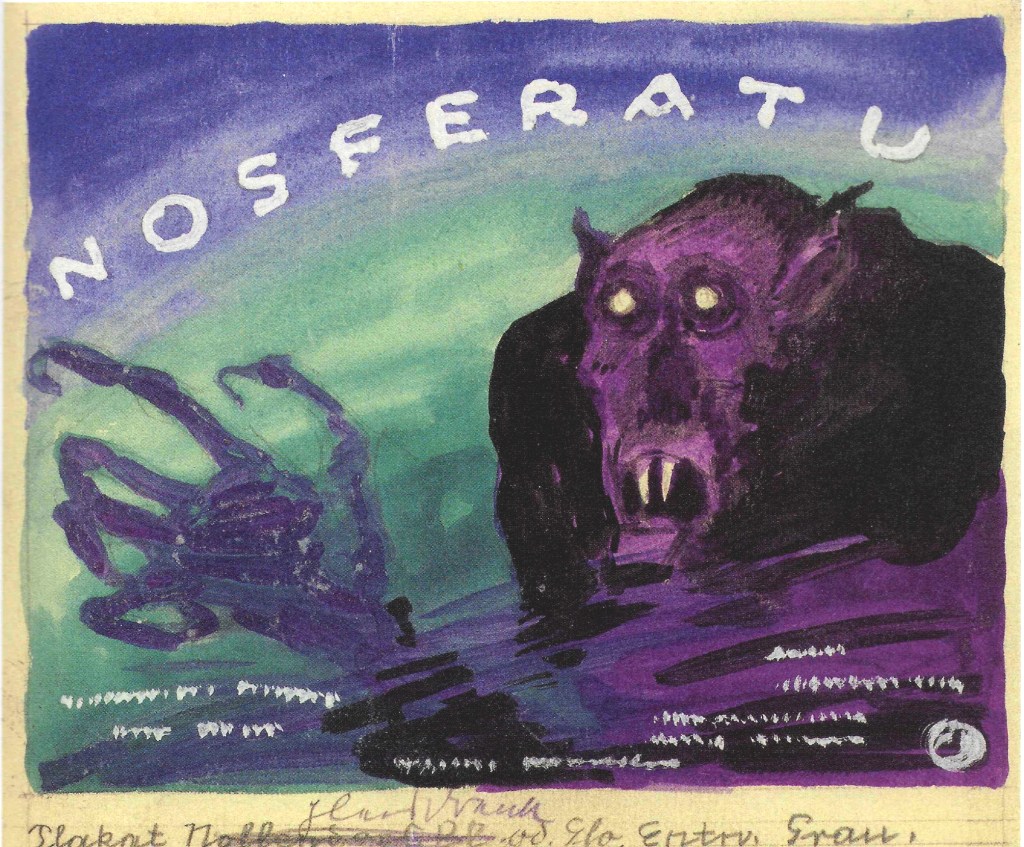
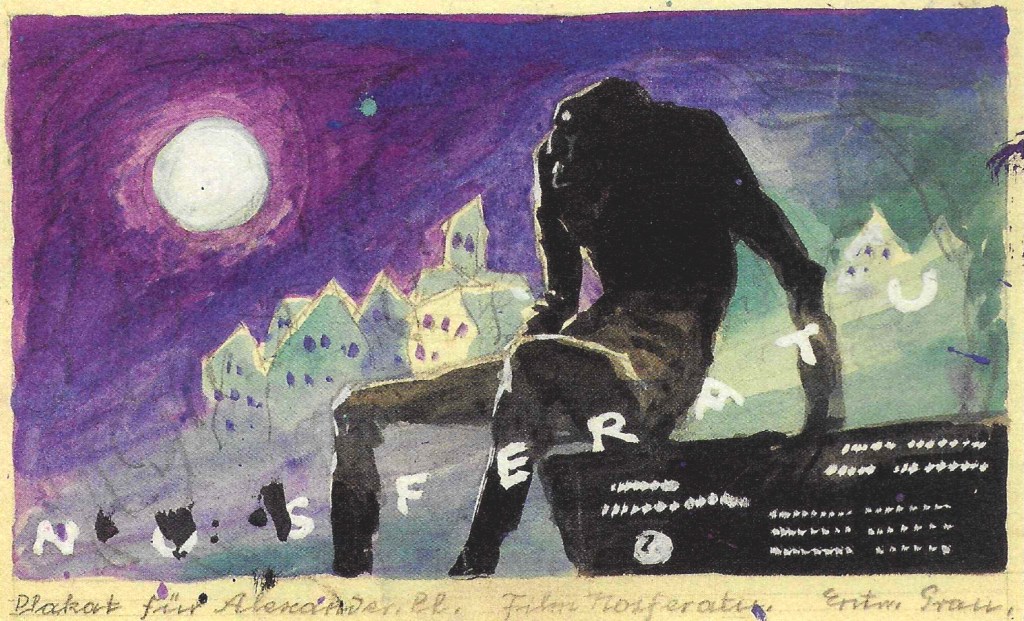
In 1921, together with Enrico Dieckmann, he founded Prana Film, the company that produced Nosferatu: A Symphony of Horror. Notably, Grau even embedded his own name within the title he conceived. But his contribution went far beyond that: he designed the costumes, sets, and storyboard, oversaw production, and created all promotional illustrations, including the film’s first haunting poster.
A devoted student of the occult, Grau was a theosophist and a pansophist, a member of both the Ordo Templi Orientis and the Fraternitas Saturni—Germany’s oldest esoteric order, whose roots trace back to Northern Europe in the 17th century. It was Grau who infused the film with symbolism: from the contract between the Count and the real estate agent Knock, written in alchemical and esoteric signs, to the very image of the vampire, which he rendered in multiple versions. The very letter “A” used in the film’s title design clearly alludes to the Masonic symbol of the inverted compass.
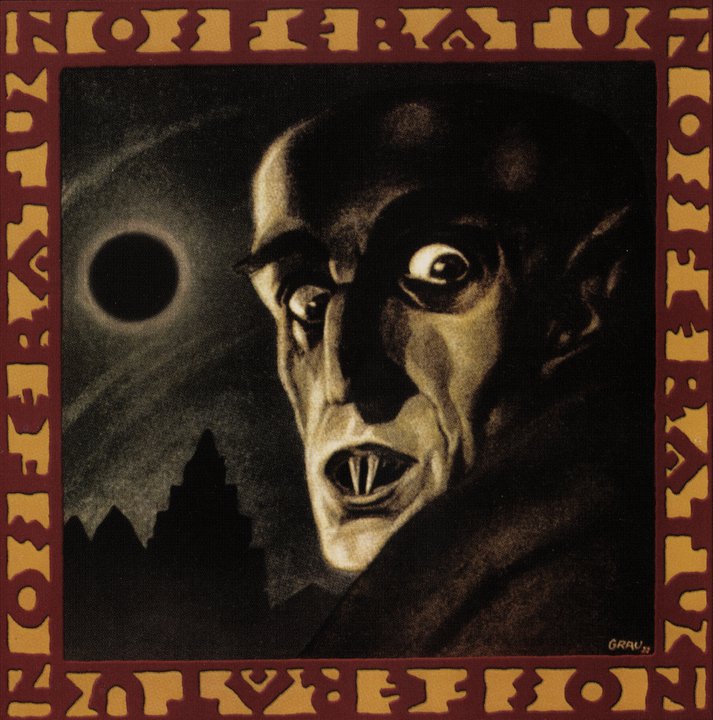
In 1922, the magazine Bühne und Film devoted its 21st issue to Nosferatu, shortly before the film’s release. On the final page, in bold type, one reads:
Nosferatu – the Immortal!
A hundred thousand thoughts assail you at the mere sound of his name—Nosferatu!
NOSFE
RATU
never dies.
Men must die. The legend tells of a vampire,
Nosferatu, “the Undying,” who feeds on human blood.
Do you wish to see the Symphony of Horror? Expect far worse.
But beware—this is no jest. Nosferatu is not to be taken lightly.
Once again we say: beware.
Within the magazine, Grau’s unsettling images accompanied a text he himself wrote, recounting the winter of 1916 during the war. Stationed in Serbia and lodged with an old peasant, he was told one night that the man’s father had been a so-called “undead,” a creature known as Nosferatu. As proof, he was shown an official document from 1884 stating that the body of a certain Morowitch—who had died without receiving the sacraments—had been exhumed without any sign of decomposition, with teeth protruding from the mouth, unusually long and sharp. The parish priest then recited the Lord’s Prayer and drove a stake through the man’s heart, ending his tormented existence once and for all. The ashes were scattered to the wind.
Although this account was most likely a promotional invention for the film, Grau’s spiritualist nature undoubtedly had a profound influence on the birth and development of the cinematic work. It should also be noted that the original opening credits of Nosferatu clearly stated: “From the novel Dracula by Bram Stoker. Freely adapted by Henrik Galeen.”
Fate, however, intervened. Bram Stoker’s widow filed a lawsuit against Prana Film for plagiarism. Combined with a massive financial deficit caused by excessive promotional expenses, the company went bankrupt just months before the film’s release. In July 1925, a Berlin court ruled in favor of Mrs. Stoker and ordered the destruction of the film. The original negative was never found.
One of Grau’s most successful illustrations established the visual rules that would give life to the creature later portrayed so masterfully by actor Max Schreck. First appearing in 1921 on the cover of the international film magazine Film-Arena, and later used in theater programs, it became the symbolic image of the film, inspiring the makeup that brought Nosferatu to life.
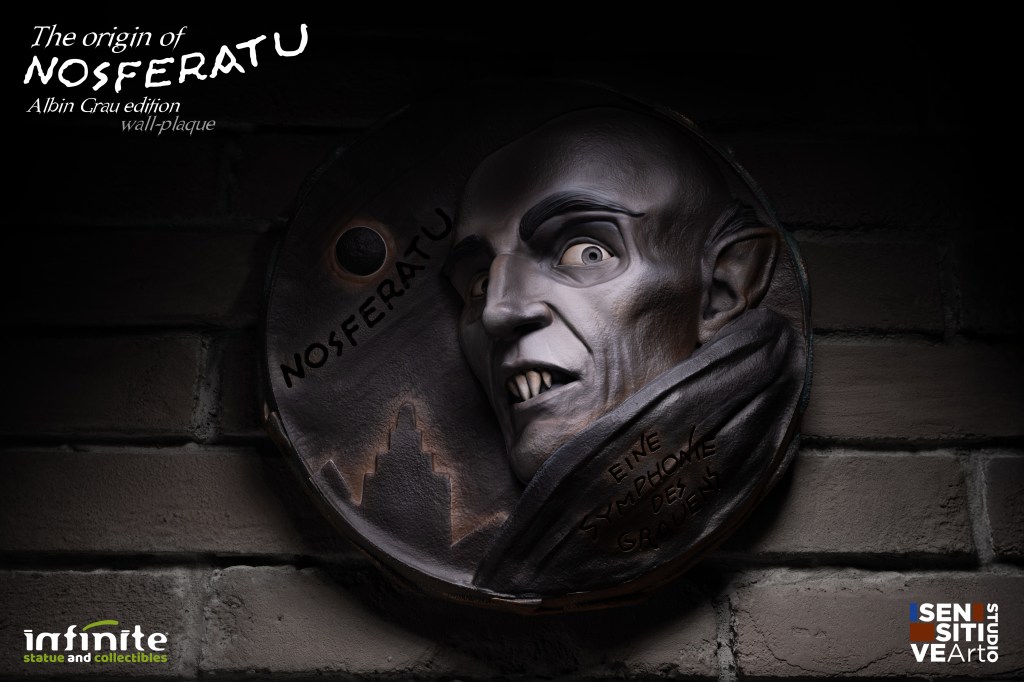
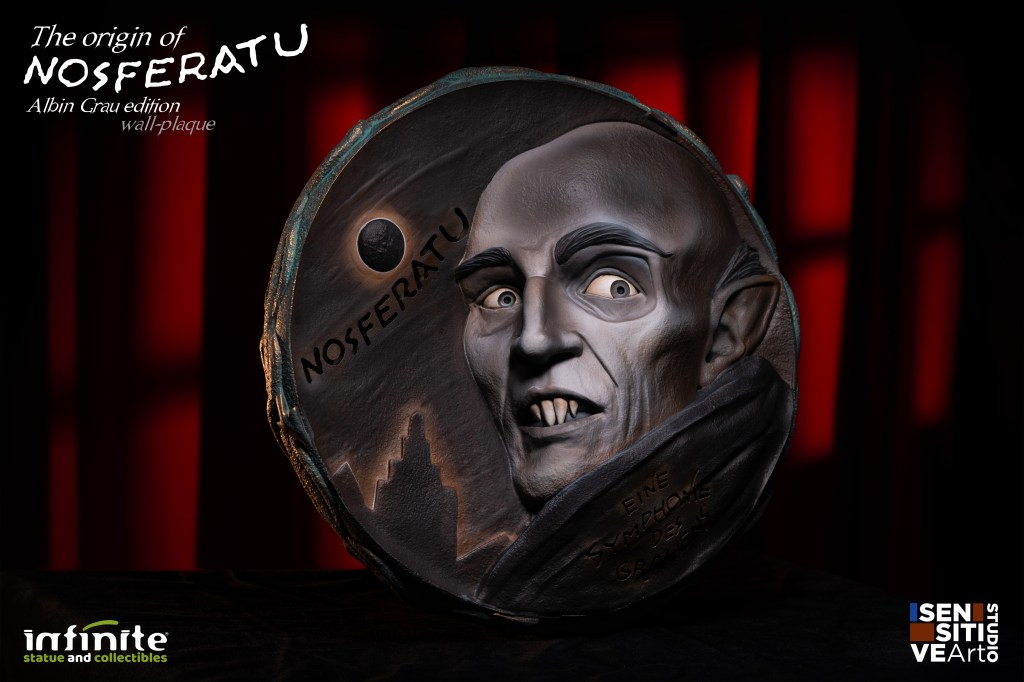
This image became the inspiration for the second project by Sensitive Art Studio, once again developed as a wall plaque—a format still relatively uncommon in the world of collectibles, yet highly effective in terms of visual impact and display possibilities. I worked closely with the sculptor on the high-relief technique, which allows for a wide range of natural and deliberately crafted shading. Physically, it becomes the exact transposition of Grau’s iconic drawing.
My intention was to give form to the primary matrix of the myth of the “undead” par excellence—a tribute to the dark and creative genius of an artist partly forgotten even by enthusiasts, yet forever the true originator of Nosferatu.
Sculpture: Rocco Tartamella
Painting: Alvise Ardenghi
Concept and Art Direction: Fabio Berruti
Research, Development and Production: Sensitive Art Studio
 Sensitive Art Studio